If my body had a name by Hoor Malas
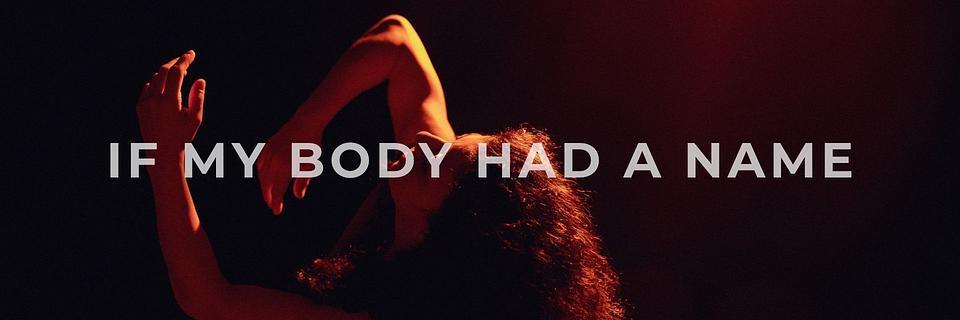
If my body had a name by Hoor Malas
My inspiration for If My Body Had a Name was sparked in 2021 while listening to an old interview with English educator Ken Robinson, in which he spoke about how we use our bodies as a form of transportation—a vehicle through which we carry our minds from one place to another. This idea led me to begin researching the mind-body problem, a longstanding philosophical question concerning the relationship between the mind and the body and their respective roles in ourdecision-making. Who is responsible for the choices we make—the mind or the body? And what happens when we begin to question the assumption that the body is simply the vehicle carrying the mind?
These questions became a starting point for thinking about my own body: what does it remember, what does it carry, and what does it know that the mind may not? How are our behaviours and ways of moving shaped by the places we come from, the people who raised us, and the social and political systems we have lived within? If the body carries our history, can we ever truly leave our past behind?
Wanting to begin from somewhere familiar and personal, I started exploring gestures rooted in my upbringing and culture, observing how these gestures resonate within my body and what they reveal about the ways I have learned to move, respond, and exist. I became interested in the possibility that a gesture can hold memory—that something as simple as the way we sit, stand, reach, greet, or respond can contain traces of where we come from. What does it mean now, as a Syrian dance artist who has been living in Canada for the past few years, to question my personal history and the social and political systems I have lived within—both where I come from and where I am now? What happens to a body when it moves between places, languages, cultures, and realities? What does the body hold onto, and what does it allow itself to let go of?
By allowing these realizations to emerge, I began to feel an urgency to share these questions through the body and through movement.
Using the artistic process to understand and feel the complexity of the self has been at the core of my choreographic work for the past few years, particularly while living and working during the war.
In this new context of being an immigrant, I have found space within myself to open the door to new yet familiar questions—questions that had been lingering in the back of my mind for years and have finally found the space to surface and take their place within this new life. Understanding who I am, and why I behave and move in certain ways, becomes a way of creating a path between the different parts of my reality: my past, my history, my body, and my present. Rather than trying to separate these parts, I am interested in bringing them into conversation with one another. If My Body Had a Name becomes a way of asking whether the body can reveal something about us that we are not yet able to articulate.
With this piece, I am also deepening my understanding of elements of my practice that centre choreography as a daily experience. I am questioning how choreography can function as a guiding structure, and to what extent a work needs to be choreographed. Through the accumulation that comes from doing something every day, I am interested in the philosophy of approaching an action as new rather than simply repeating what has already been done.
Ultimately, If My Body Had a Name is an exploration of the body as a living archive: a place where memory, culture, history, emotion, and transformation meet. It is an attempt to listen more closely to what the body carries and to consider what it might say if it could speak for itself. To honour and celebrate all the different parts that make us who we are becomes, for me, an act of recognition and acceptance—and an act of hope.
Credits:
Choreography and performance: Hoor Malas
Music: Shadi Ali
Rehearsal Director: Neil Sochasky
Costumes: Sonya Bayer
Original lighting plan: Marko Croteau
Photography: Thibault Carron
Teaser: Youssef Shoufan
This work had the support for creation residency and production: Canada Arts Council, MAI + Montréal Arts Council, Danse à la carte, Place des Arts, Circuit Est and MAI.
This work had the support for touring in 2026: CALQ (Conseil des arts et des lettres du Québec)
By confirming your purchase, you agree to the ticket conditions set by the organiser.
** Fee is tax inclusive